In this previous post, I said I hoped our new addition of a Latin curriculum would be productive.
Update: We don't do it.
We do memorize our CC Latin, though. [Thunderous applause, please.]
The End.

Showing posts with label 1st grade. Show all posts
Showing posts with label 1st grade. Show all posts
Friday, December 26, 2014


Thursday, July 31, 2014
Plans for 3rd and 1st
Rebekah brought it to my attention that Thing1 is no longer a beginner. At the end of third grade, he will be halfway to junior high! And Thing2 is a 1st grader. It's gonna get real for him this year.
Here's the plan for both of them:
Classical Conversations Memory Work from the Foundations Guide along with printables from CC Connected.

If we don't do anything else in a day, we do this. My favorite way to keep track of practicing the memory work is to use a Charlotte Mason memory box. Here's a link to an instructional video.
__________________________
Story of the World Volume 3: Early Modern Times

Of course, this book contains wonderfully told stories. But the activity book provides enough corresponding literature suggestions to keep us busy for the next three years. The maps and coloring pages are great, too, but not as useful to us this year. Unless it an epic battle scene, the boys really don't care to color, and we get enough geography from CC that we can usually picture the general location we are reading about. Our routine is to read a chapter while coloring from the activity book then type up a narration page with a picture cut and pasted from the Internet. The narration pages go into their history notebooks. We try to have library books from the activity book's corresponding literature list on hand always.
__________________________
Apologia's Exploring Creation with Anatomy and Physiology


Here's the plan for both of them:
Classical Conversations Memory Work from the Foundations Guide along with printables from CC Connected.
If we don't do anything else in a day, we do this. My favorite way to keep track of practicing the memory work is to use a Charlotte Mason memory box. Here's a link to an instructional video.
__________________________
Story of the World Volume 3: Early Modern Times
Of course, this book contains wonderfully told stories. But the activity book provides enough corresponding literature suggestions to keep us busy for the next three years. The maps and coloring pages are great, too, but not as useful to us this year. Unless it an epic battle scene, the boys really don't care to color, and we get enough geography from CC that we can usually picture the general location we are reading about. Our routine is to read a chapter while coloring from the activity book then type up a narration page with a picture cut and pasted from the Internet. The narration pages go into their history notebooks. We try to have library books from the activity book's corresponding literature list on hand always.
__________________________
Apologia's Exploring Creation with Anatomy and Physiology
Apologia's Exploring Creation books are just plain fun. The pre-made Notebooking Journals are an unbelievably simple way to compile a super cute science notebook. Thing2 is excited that he has his own notebooking journal this year.
__________________________
Song School Latin

I add one new thing each year. This year it's Latin. Hopefully it will be profitable.
_____________________________
Here's what we've got planned for the third grader:
__________________________
Song School Latin
I add one new thing each year. This year it's Latin. Hopefully it will be profitable.
_____________________________
Here's what we've got planned for the third grader:
Slow and steady is the name of the game for Thing1 and mathematics, and Math-U-See fits the bill. Plus, Mr. Demme's short lessons on the DVD are much more effective than my blundering.
_____________________________
Growing With Grammar, Level 3

Levels 1 and 2 served us well. Considering that this is our last year before Essentials of the English Language through Classical Conversations, why quit now? Level 3 introduces diagramming sentences. (I am excited! Nerd.) I considered buying Digging into Diagramming for extra practice, but then I realized that it doesn't take a $15 book to practice diagramming.
______________________________
Writing With Ease, Year 3

Agenda for our third and final year of WWE: Reading, narration, copywork, dictation; repeat.
I have decided not to buy the workbook this year. Instead, I am going to use McGuffey's Eclectic Readers (John Wiley and Sons, 1879) for the exercises. If it doesn't work (i.e. we skip it because it takes too much time to prep), I will just download the workbook. I'm also toying with the idea of using the McGuffey's for spelling as well. More on this endeavor later.
_______________________________
Prescripts Cursive Words and Drawing: Math Terms

Normally handwriting books are the first thing to be dropped when we are short on time, but these books have them writing things they should be memorizing anyway, so it seems more productive.
_______________________________
The plan for our first grader:
Alpha Math-U-See

I already had everything but the student workbook from when Thing1 did it two years ago. After buying the workbook, I decided to make copies of the consumable pages this year. These books get expensive!
Thing2 did well in the Primer math book last year, and I don't regret my decision to do the kindergarten math program. I think he will be well prepared for Alpha this year, but I am still bracing myself for the task of making him memorize all the addition facts.
______________________________
Growing with Grammar, Level 1

I discussed here my decision to use GWG and Writing with Ease in first grade for Thing1. I was satisfied, so we are doing it again. My worries about it not being enough for a well rounded language arts are obsolete. With Classical Conversations memory work, GWG, WWE, Prescripts, and all the reading we do in Story of the World, I believe we cover language arts sufficiently.
________________________________
Writing With Ease, Level 1

This was easy because I already own the Level 1 workbook in PDF format. I like being able to print of the pages as I need them.
With the workbook, there is virtually no preparation for these lessons, and the book excerpts are always interesting: Little House, Peter Rabbit, Caddie Woodlawn, and The Railway Children to name a few. Both Level 1 and 2 workbooks stretched Thing1's reading repertoire because he almost always wanted to read the whole book after he heard an excerpt from it.
_______________________________
Prescripts Cursive Letters and Coloring: World History

Why not start cursive in the first grade like they did in the olden days? After this year, I will know. Each opening has a page of cursive letter practice and a picture from the Timeline Cards that he can color.
_______________________________
Finally, to pull it all together, I bought a Well Planned Day planner.

I decided to go with a premade paper planner this year for the first time. I am not convinced I really need it, but I want to try it out.
Again, a good school day does not have to include everything I have listed here. CC memory work, math, and language arts are the core. The rest is extra. These plans, like all plans, are a guide and always a work in progress. They are as flexible as we are. We use them to be productive, but we will not let them run our lives.
_____________________________
Growing With Grammar, Level 3
Levels 1 and 2 served us well. Considering that this is our last year before Essentials of the English Language through Classical Conversations, why quit now? Level 3 introduces diagramming sentences. (I am excited! Nerd.) I considered buying Digging into Diagramming for extra practice, but then I realized that it doesn't take a $15 book to practice diagramming.
______________________________
Writing With Ease, Year 3
Agenda for our third and final year of WWE: Reading, narration, copywork, dictation; repeat.
I have decided not to buy the workbook this year. Instead, I am going to use McGuffey's Eclectic Readers (John Wiley and Sons, 1879) for the exercises. If it doesn't work (i.e. we skip it because it takes too much time to prep), I will just download the workbook. I'm also toying with the idea of using the McGuffey's for spelling as well. More on this endeavor later.
_______________________________
Prescripts Cursive Words and Drawing: Math Terms
Normally handwriting books are the first thing to be dropped when we are short on time, but these books have them writing things they should be memorizing anyway, so it seems more productive.
_______________________________
The plan for our first grader:
Alpha Math-U-See
I already had everything but the student workbook from when Thing1 did it two years ago. After buying the workbook, I decided to make copies of the consumable pages this year. These books get expensive!
Thing2 did well in the Primer math book last year, and I don't regret my decision to do the kindergarten math program. I think he will be well prepared for Alpha this year, but I am still bracing myself for the task of making him memorize all the addition facts.
______________________________
Growing with Grammar, Level 1
I discussed here my decision to use GWG and Writing with Ease in first grade for Thing1. I was satisfied, so we are doing it again. My worries about it not being enough for a well rounded language arts are obsolete. With Classical Conversations memory work, GWG, WWE, Prescripts, and all the reading we do in Story of the World, I believe we cover language arts sufficiently.
________________________________
Writing With Ease, Level 1
This was easy because I already own the Level 1 workbook in PDF format. I like being able to print of the pages as I need them.
With the workbook, there is virtually no preparation for these lessons, and the book excerpts are always interesting: Little House, Peter Rabbit, Caddie Woodlawn, and The Railway Children to name a few. Both Level 1 and 2 workbooks stretched Thing1's reading repertoire because he almost always wanted to read the whole book after he heard an excerpt from it.
_______________________________
Prescripts Cursive Letters and Coloring: World History
Why not start cursive in the first grade like they did in the olden days? After this year, I will know. Each opening has a page of cursive letter practice and a picture from the Timeline Cards that he can color.
_______________________________
Finally, to pull it all together, I bought a Well Planned Day planner.
I decided to go with a premade paper planner this year for the first time. I am not convinced I really need it, but I want to try it out.
Again, a good school day does not have to include everything I have listed here. CC memory work, math, and language arts are the core. The rest is extra. These plans, like all plans, are a guide and always a work in progress. They are as flexible as we are. We use them to be productive, but we will not let them run our lives.
Thursday, May 2, 2013
Three Down!
Today we finished Growing with Grammar Level One!

A week or so ago, we finished Flying Creatures of the Fifth Day!
Last week we finished Alpha Math-U-See!
My focus remains on learning rather than finishing books, and I'm trying not to let the satisfaction of completion skew my purpose...but it sure feels good to knock 'em out!
Still to finish: Writing with Ease Level 1, Story of the World Volume One, and Mind Benders Book 2.
Ongoing: Math Drills (great link for drill sheets no matter what program you use) and Spelling Power.

A week or so ago, we finished Flying Creatures of the Fifth Day!
Last week we finished Alpha Math-U-See!
My focus remains on learning rather than finishing books, and I'm trying not to let the satisfaction of completion skew my purpose...but it sure feels good to knock 'em out!
Still to finish: Writing with Ease Level 1, Story of the World Volume One, and Mind Benders Book 2.
Ongoing: Math Drills (great link for drill sheets no matter what program you use) and Spelling Power.
Saturday, March 9, 2013
Spelling Power
At the beginning of the second semester of first grade, we needed a spelling program because Thing1 had outgrown our Reading Reflex routine.
I remember my mother liking Spelling Power for some of her children, and I have a friend who uses it currently and recommends it highly. I decided to give it a try.
Here's why I love it:
I remember my mother liking Spelling Power for some of her children, and I have a friend who uses it currently and recommends it highly. I decided to give it a try.
Here's why I love it:
- Buy one book, and you have spelling lists for elementary through adult levels.
- A placement test determines the student's level rather than using a "first grade" or "second grade" list. In other words, the spelling words are always challenging.
- The student takes a five-minute test every day and only has to study the words he misses on the test. Tomorrow, he will have only the words he missed from today's test plus more new ones.
- Using the methods Spelling Power outlines to study the missed words really works to solidify the spelling in the student's memory. There are even some Montessori-inspired components.
- And here's the big one: For a student to whom first grade academics come easily, it is great to have ten minutes (or more, depending on attitudes) a day when that student gets to learn how to get something wrong, study, and try again.
Unfortunately, Thing1 does not share my love for this program, but he did approve this post before publishing.
**This is a real review. No compensation.**
**This is a real review. No compensation.**
Tuesday, March 5, 2013
Biblical Science
We don't use strictly "Christian" curriculum. I'll leave it at that for now since the reasons would be more adequately presented in a lengthy post...which I don't have time for.
However, one subject I really like to keep Biblical (to me, Biblical is a more appropriate adjective than Christian in this discussion) is science. Evolution permeates every natural-science-related book, video, or TV show. The kids learned at an early age to say, "That's not true" every time they heard or read something that said, "millions of years ago..."
History is largely the study of human behavior and accomplishments, and language arts is the study of human communication, but science is the study of God's creation. The more we understand about natural science, the more we realize how little we understand of God's power. I like a science curriculum that acknowledges and even proves that creation is true (for my kids' and my benefit). If evolution is so widely accepted as fact that dinosaur board books for babies advocate it, I want my kids to be grounded in the truth of creation while they are homeschooled because they are not going to get it anywhere else.
By the way, we used Exploring Creation with Zoology I, Flying Creatures of the Fifth Day this year and have thoroughly enjoyed it. The text book is worthy of reading just for fun, and the notebooking journal is fun for the kids and easily prepared (as in no prep) by Mom.
Another by the way: this post is strictly my opinion and was written on my own incentive. I did not and will not receive any compensation for it.

![]()
However, one subject I really like to keep Biblical (to me, Biblical is a more appropriate adjective than Christian in this discussion) is science. Evolution permeates every natural-science-related book, video, or TV show. The kids learned at an early age to say, "That's not true" every time they heard or read something that said, "millions of years ago..."
History is largely the study of human behavior and accomplishments, and language arts is the study of human communication, but science is the study of God's creation. The more we understand about natural science, the more we realize how little we understand of God's power. I like a science curriculum that acknowledges and even proves that creation is true (for my kids' and my benefit). If evolution is so widely accepted as fact that dinosaur board books for babies advocate it, I want my kids to be grounded in the truth of creation while they are homeschooled because they are not going to get it anywhere else.
By the way, we used Exploring Creation with Zoology I, Flying Creatures of the Fifth Day this year and have thoroughly enjoyed it. The text book is worthy of reading just for fun, and the notebooking journal is fun for the kids and easily prepared (as in no prep) by Mom.
Another by the way: this post is strictly my opinion and was written on my own incentive. I did not and will not receive any compensation for it.
Thursday, January 24, 2013
Cooler.
I love Story of the World, but I do shy away from building complicated replicas.
In Chapter 12, one project idea was to use tiny dowel rods and a small gift box to build an Egyptian chariot then play like an Egyptian prince is running out the Hyksos. As always, Satori Smiles (hers is pictured below) has an excellent example of the project.

Beautiful. And very realistic.
However, the first question I ask when considering a history project is this: "Can it be done with Legos?" If the answer is "yes," we will attempt the project. And by "we," I mean Thing1.
Thing1's chariot:

When I asked about the guns and lights, his explanation was, "It's like the Egyptians, only cooler. It's a nowadays motor-powered chariot."
Thursday, October 25, 2012
Handwriting Without (very many) Tears
Just to clear up any misunderstandings, when they say "Handwriting Without Tears," they do not mean that there are literally no tears. They just mean that it produces less tears than other handwriting programs that do not claim to be tear-free.
Today was an especially tearful day, so we took Mary Poppins' advice and tried a spoonful of sugar. (Actually, I have a new friend who told me she does this with her seven-year-old son, and it sounded brilliant to me.)

Nine Smarties. Just a spoonful. No more tears!

Today was an especially tearful day, so we took Mary Poppins' advice and tried a spoonful of sugar. (Actually, I have a new friend who told me she does this with her seven-year-old son, and it sounded brilliant to me.)

Nine Smarties. Just a spoonful. No more tears!
Wednesday, October 3, 2012
Notebooking Confession, List of Insect Photo Sites, and a Moral
Instead of drawing pictures to go along with all the narrations in our Flying Creatures of the Fifth Day Junior Notebooking Journal (Apologia), we print photos from the Internet.
Just in case someone else out there has a first grade son with a slight pencil allergy...and just in case that someone needs permission to take a shortcut for the sake of a parent/child relationship, here are a few good insect photo sites:
National Geographic
The best way to search for an insect or animal photo is to use the search box in the top right corner.
InsectIdentification.org
We found a great picture of a molting cicada.
Alex Wild Photography
 Our favorite. Before I printed, I checked their conditions for image use, and it specifically allows students and teachers to use the photos for educational purposes.
To print the photos, I use the Windows Snipping Tool, save the photo in a folder I labeled "insect study," then print in wallet or contact paper size, depending on the space in the Notebooking Journal. Very simple.
Finally, the moral: Thing1 began illustrating some narrations without complaint after we began printing most of the pictures. It is amazing how much a kid (and his mother) can accomplish when he (or she) is not overwhelmed.

Saturday, September 29, 2012
It's okay to build your pyramid with Legos.
Sugar Cube Pyramid. Great idea! Looks like fun. Hands-on learning.
Too complicated. Not enough time. (Three to six hours for the glue to dry? No way.) Skipping to next page of SOTW Activity Book.
Whoa! Stop turning the page.
"OR you can use 55 square Lego blocks."
Hmm.
No sugar cubes. (Who keeps sugar cubes in the pantry, anyway?)
No glue.
No mess.
10 minutes later, Thing1 is thrilled with his pyramid, and we have enough time left to make Khufu.

The homeschooler's compromise: Where ideal and real meet.


Too complicated. Not enough time. (Three to six hours for the glue to dry? No way.) Skipping to next page of SOTW Activity Book.
Whoa! Stop turning the page.
"OR you can use 55 square Lego blocks."
Hmm.
No sugar cubes. (Who keeps sugar cubes in the pantry, anyway?)
No glue.
No mess.
10 minutes later, Thing1 is thrilled with his pyramid, and we have enough time left to make Khufu.

The homeschooler's compromise: Where ideal and real meet.

Tuesday, September 18, 2012


Saturday, September 1, 2012
A Mosquito Named Thunder
This first grade homeschool business is crazy. It is changing me.

I have never ever intentionally stored an insect in my refrigerator until last week. I have never ever been excited to find an insect inside my home until today. In my past, the mosquito lounging on my dining room wall would have horrified me until it was flattened. Not anymore. Life is our schoolroom, right?
I did not flatten the mosquito. I hollered for Thing2 to stand still while I [ran and] retrieved our bug-catching jar out of the science lab kit. Once captured, Thing1 inspected it, concluded that it was indeed an insect (Yep. There are six legs, a head, thorax, and abdomen.) and promptly went back to his Peter Pan audiobook. However, Thing2 and I ogled it with magnifying glasses, discussed the intriguing feature we noticed, and confirmed what we had read in Flying Creatures of the Fifth Day. In fact, Thing2 affectionately called him (or her) Thunder after spending about an hour with it.
It thrills me that I am not the only one in the house who appreciated a live captive mosquito.

Monday, August 27, 2012
Famous Figures of Ancient Times: King Narmer
Today we used our Famous Figures of Ancient Times, which was [one of] my non-essential splurge[s] in curriculum shopping this year, for the first time.
What I did not realize when I purchased this book of 21 movable figures of historical characters (including Moses, Aristotle, Hannibal and his elephant) is that the book includes two copies of each character: one in color and one in black and white.
Perfect! One for each kid.
Today we made Narmer, a Pharaoh of Ancient Egypt, and each boy dictated something about him for their notebooks. We used a 1/8" hole punch and mini brads from the scrapbooking aisle at Michael's.

Making King Narmer dance occupied and entertained Thing2 for quite a while this morning.
I shy away from cluttery projects because the kids do not want to throw away something they work hard on. However, if we keep everything they work hard on, it takes about a day for the house to be overrun with cluttery projects. To store this, I put the doll and the narration in a page protector so it would fit nicely in their notebooks. I like projects that lie flat.


If I am able, I will buy the Medieval set and the American Revolution set when we need them, but 6 and 4 seem to be perfect ages for this. Who knows if they will still like to make paper dolls by the time we are studying American History? Making the figure sparked much more conversation about the character and his time period than just reading about him. Granted, there are ways to get the same result without spending $20, but in this homeschool, projects do not happen unless they are easy. And this is easy.
The CBD links are affiliate links, but no one is paying me to write about Ancient Figures. I like it, and I thought you might, too!
What I did not realize when I purchased this book of 21 movable figures of historical characters (including Moses, Aristotle, Hannibal and his elephant) is that the book includes two copies of each character: one in color and one in black and white.
Perfect! One for each kid.
Today we made Narmer, a Pharaoh of Ancient Egypt, and each boy dictated something about him for their notebooks. We used a 1/8" hole punch and mini brads from the scrapbooking aisle at Michael's.

Making King Narmer dance occupied and entertained Thing2 for quite a while this morning.
I shy away from cluttery projects because the kids do not want to throw away something they work hard on. However, if we keep everything they work hard on, it takes about a day for the house to be overrun with cluttery projects. To store this, I put the doll and the narration in a page protector so it would fit nicely in their notebooks. I like projects that lie flat.

Ever the perfectionist, Thing1 could not finish coloring and cutting his figure before lunch time. We might have to take turns with the color and black and white figures so Thing1 is not always stuck with the coloring.

Bonus feature: There is a mini bio with a small picture of each character at the beginning of the book. I cut out the tiny picture and glued it to our timeline.
The CBD links are affiliate links, but no one is paying me to write about Ancient Figures. I like it, and I thought you might, too!
Tuesday, August 21, 2012
First Day of School: English
Our English consists of Growing with Grammar, Writing with Ease and The Complete Writer Level One Workbook, Handwriting Without Tears, and Reading Reflex for spelling.
I chose Growing with Grammar instead of First Language Lessons to go with Writing with Ease to avoid repetition and to get a slightly different perspective instead of going with everything Well-Trained Mind. Also, I couldn't get over the fact that FLL is written by Jessie Wise, who wrote The Ordinary Parent's Guide to Teaching Reading, which I did not love. Another advantage to GWG is its simplicity. It is black and white. He does the front and back of one page every day. There are not separate teacher's volumes and student workbooks. The one spiral-bound volume is instructional book and workbook all in one. I felt we needed this in grammar (a subject that is comfortable for Thing1) since the rest of our day is pretty teacher intensive.
But you know me. I will find something to worry about. I worried if GWG is too simple. Will he get a good foundation in grammar without the scripted approach of First Language Lessons or Shurley English? I concluded that he would. And if he doesn't, there is always next semester or next year.
So far, it has been great! The daily chunks are small, but they are complete. He can even do them independently when he needs to. I am satisfied.


I chose Growing with Grammar instead of First Language Lessons to go with Writing with Ease to avoid repetition and to get a slightly different perspective instead of going with everything Well-Trained Mind. Also, I couldn't get over the fact that FLL is written by Jessie Wise, who wrote The Ordinary Parent's Guide to Teaching Reading, which I did not love. Another advantage to GWG is its simplicity. It is black and white. He does the front and back of one page every day. There are not separate teacher's volumes and student workbooks. The one spiral-bound volume is instructional book and workbook all in one. I felt we needed this in grammar (a subject that is comfortable for Thing1) since the rest of our day is pretty teacher intensive.
But you know me. I will find something to worry about. I worried if GWG is too simple. Will he get a good foundation in grammar without the scripted approach of First Language Lessons or Shurley English? I concluded that he would. And if he doesn't, there is always next semester or next year.
So far, it has been great! The daily chunks are small, but they are complete. He can even do them independently when he needs to. I am satisfied.

I love Susan Wise Bauer's Writing with Ease. It is also in bite-sized chunks. The ideal homeschool mother would pick up something she has been reading aloud to her classical child and choose a passage for copywork, dictation, or narration from that. But for imperfect homeschoolers like myself, the workbook (I opted for PDF format from Peace Hill Press so that I could print pages as needed for each of the kids) is great. I never have to crack a book the night before. The literature selections are already made and printed in the workbook. As if the author predicted that I would feel a little guilty about using snippets of literature, she included a list of all the works used in the workbook. My job is as simple as going to the library and borrowing the books in their entirety for Thing1 to read if he is so inclined, which he usually is. One more thing: The copywork exercises include a short sentence and a long sentence so that the teacher can decide which is more appropriate for the student.

Handwriting Without Tears is what it is. The only difference in Printing Power, the 2nd grade workbook, and the 1st grade workbook is that the lines are smaller, and the subject matter for writing practice is a little more grown up.
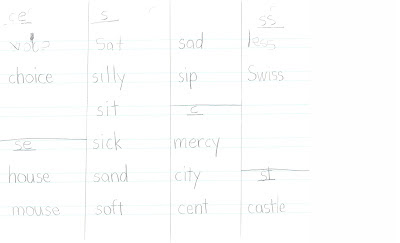
For spelling, we are picking up where we left off last year in Reading Reflex. No major adjustments. More of the same wonderfully systematic organization of sounds.

The physical act of writing is still overwhelming. I am writing for Thing1 half the time except for in handwriting and copywork in hopes that he will not end up with a pencil allergy. In one week and one day, his writing has already become more automatic.
Monday, August 20, 2012
First Day of School: History

On our first school day, we read about historians and archaeologists.
After we had read some books about archaeology, especially Archaeologists Dig for Clues by Kate Duke, the boys were so enthralled that I suggested they play like archaeologists during the afternoon. (Actually it was suggested in Story of the World, but I had planned on skipping it...of course.)
It has been one week since then, and I am pretty sure they have played archaeologist every day. I know I have wiped sand from the bathroom sink and tub every day. They keep trowels, paint brushes, an old toothbrush, a watering can, and lots of other tools in a plastic pail hanging on a peg in their room. When they go outside, so does the pail.

The opportunity to sit and write a comprehensive "first day" post continues to elude me.
Thursday, August 16, 2012
After tomorrow, the first week of school will be history.
I need to do a "first day of school post" since my computer is back home safe and sound. I'll try that once I have everything reinstalled. Fun.
Here's a quick rundown:
It started out rough. Then it got better.
Pictures soon.
Monday, August 13, 2012
The very last first day. 5:07 p.m.
I am glad I only commit to one year at a time.
Three hours until bedtime?
Thing1's very last first day of first grade
is today.
Lengthy post later when my computer comes home from the shop.
The schedule says I should wake them up at 7:00.
4...3...2...1
And we're off!
Tuesday, July 17, 2012
Don't Forget Why.
When The Husband and I decided to
homeschool Thing1 in kindergarten, we determined to make a year-by-year
decision instead of committing to 13 years of homeschool when he was five years
old. At the same time, I decided to put my reasons into writing each year. When
my thoughts are recorded in black and white, I can see the foolishness and the wisdom
more clearly. I also hope that writing out why I am homeschooling each year will make me accountable to reality. If the day ever comes when it is not working any more, being committed to giving reasons each year should help me to realize that.
Our decision for first grade in 2012-13
is (obviously) to homeschool. Our favorite reasons are character training, tailored
academics, effective use of time, and selfishness on my part. Before kindergarten,
we perceived the lack of social interaction with his age group and teachers who
are not related to him as a drawback (mainly due to his extreme shyness) and an
advantage (due to parental control over social experiences). Looking back over
the year, the advantages have outweighed the drawbacks. His participation in swim
lessons, t-ball, and co-op classes have shown us that Thing1 has made great strides in overcoming his shyness
and fear of people despite (or maybe because of) homeschooling in kindergarten.
First, homeschooling fits The Husband’s
and my purpose for our family. We feel that the most important training is character
training. If we do not impart good moral and ethical values to our children,
the most advanced academic plan will be meaningless. I know it is possible to “train
up a child” who is schooled traditionally, and I have great respect for the
parents who accomplish it. However, when I look at the vast amount of time and
attention that we spend on this task in the early years, I know it would be
difficult – maybe impossible – for me.
Even though I do not expect to see perfection in humans, I pray that our
intense concentration this year on eliminating whining and the recognition of
privileges in relation to responsibilities, to name two, has planted some seeds
for these boys’ futures.
During these first years, we want
to focus on the joy of learning rather than the fear of not measuring up on
benchmark exams. If the kids enjoy learning, I believe they will do well later
on when the tests really matter. I am excited about choosing
our curriculum this year with Thing1 in mind. He is a reader. He advanced from Henryand Mudge to Ralph S. Mouse during his kindergarten year, and he
reads fiction and non-fiction with equal enjoyment. Therefore, we are going with
a literature-intense curriculum. I even bought Life of Fred for math since it
is story-based and applies the math to real life (albeit a tad far-fetched)
situations. He struggled with the monotony of Math-U-See practice sheets, but
we are still going to do those as a supplement to Life of Fred. I know he will
enjoy Story of the World for History because it requires lots of reading. Another
concentration is preparation for writing. The end goal in educating our
children is that they are able to think and communicate their thoughts
effectively. Thing1 might get that in a school setting, but the one-on-one
training in our homeschool definitely will not hurt.
Our third reason for
homeschooling this year is that homeschooling affords us the opportunity to use
our time effectively. I say opportunity because whether or not we actually use the
time wisely varies from day to day, but the opportunity is still there. Yes,
the boys have large chunks of time to play, which is very important for kids. But
as they get older, another important aspect is that they also have large chunks
of time to work. They (and their daddy) would miss the time they get to work on
projects other than school and homework in the classroom school scenario. When
their dad is home, they are by his side working on whatever project he is
working on and thereby learning how to work. They do not work with Dad instead
of doing schoolwork. They are able to work because their schoolwork is concentrated
to a shorter amount of time, which leaves more time afterwards for work…and
play.
Finally, we are homeschooling
this year because I like it. I like the fact that I am forced to work on my own
character while I am helping them with theirs because teaching without example
is worthless. I like the fact that I am building on what I learned and learning
what I did not learn while I was school-aged. Researching in the name of
homeschooling helps me develop an understanding of the way we learn, which helps
me deal with myself and even others outside my family. I love that I get to see
the kids’ daily progress and get to witness their light bulb moments. I love
that I can spend so much time with my boys during the short, short time that
they are with me.

Sunday, July 1, 2012
Susan Wise Bauer on You Tube
Oh. My. Lollipop. (As Thing2 would say.)
I just found the answer to one of my questions (Writing with Ease and First Language Lessons?) answered by Susan Wise Bauer, herself, on YouTube! In fact, there is a Peace Hill Press YouTube channel. Of course I subscribed.
I might be the last Well Trained Mind fan to discover this. But just in case there is someone else who reads this and who cares about a Peace Hill Press YouTube channel, I wanted to share.
I just found the answer to one of my questions (Writing with Ease and First Language Lessons?) answered by Susan Wise Bauer, herself, on YouTube! In fact, there is a Peace Hill Press YouTube channel. Of course I subscribed.
I might be the last Well Trained Mind fan to discover this. But just in case there is someone else who reads this and who cares about a Peace Hill Press YouTube channel, I wanted to share.
Tuesday, June 19, 2012
Thing1 told me he would like to go to public shool for first grade.
This was not the first time he has mentioned it, but since we were alone this morning and things were calm, I thought it would be a good time to talk about it.
The challenge was to convey the advantages of homeschool to him without being negative about public schoolers. I would feel horrible if after touting the advantages of homeschool, he left our conversation with the impression that his public school friends are disadvantaged. Then I would feel even more horrible if he repeated the conversation to them as if he were more privileged than they were. (I knew some kids like that growing up, and it was not nice.)
I started by telling him that I was glad he told me his feelings. I would much rather hear the kids' feelings, likes, and dislikes in a respectful way than to think they are scared to tell me. Then I told him that although there were good things about public schools, The Husband and I have prayed about it and believe that homeschooling is the best option for our family right now.
Finally, I tackled the sticky part: How to cause Thing1 to appreciate the advantages of homeschooling without feeling prideful about it. I told him that I thought he would get excited about the things I had planned for first grade. "Like what?" I was happy he was interested. I told him about my plans including music lessons and emphasized the reading he would do (he loves stories and has already read some of the historical books I have accumulated for next year), Next I explained the public school schedule compared to our schedule and listed some things that he would have to give up if he committed to a public school schedule. He seemed to accept the information positively, especially when I focused on his favorite time of day, free reading during rest time.
As the conversation dwindled, I had an afterthought that I am so thankful for now. I asked him what part of public school he thinks he would like. I discovered that he thought he could go to his cousins' school (not our school district) and that he knows that they do a lot of crafts because he saw the craft room once when we were there. Ahhh. I'm glad I closed my mouth and listened. I explained to him about school districts and proposed that we plan a weekly craft for first grade.
Thing1's conclusion was, "I'd like to homeschool."
"By the way," I mentioned as Thing1 started up Mario Brothers on his DS. "They don't allow you to take a DS or any other toy to school with you, so you can't do this after your work is done like you can here."
Thing1's mouth gaped in surprised. "I didn't know that, but now I do. Thanks for telling me."
The challenge was to convey the advantages of homeschool to him without being negative about public schoolers. I would feel horrible if after touting the advantages of homeschool, he left our conversation with the impression that his public school friends are disadvantaged. Then I would feel even more horrible if he repeated the conversation to them as if he were more privileged than they were. (I knew some kids like that growing up, and it was not nice.)
I started by telling him that I was glad he told me his feelings. I would much rather hear the kids' feelings, likes, and dislikes in a respectful way than to think they are scared to tell me. Then I told him that although there were good things about public schools, The Husband and I have prayed about it and believe that homeschooling is the best option for our family right now.
Finally, I tackled the sticky part: How to cause Thing1 to appreciate the advantages of homeschooling without feeling prideful about it. I told him that I thought he would get excited about the things I had planned for first grade. "Like what?" I was happy he was interested. I told him about my plans including music lessons and emphasized the reading he would do (he loves stories and has already read some of the historical books I have accumulated for next year), Next I explained the public school schedule compared to our schedule and listed some things that he would have to give up if he committed to a public school schedule. He seemed to accept the information positively, especially when I focused on his favorite time of day, free reading during rest time.
As the conversation dwindled, I had an afterthought that I am so thankful for now. I asked him what part of public school he thinks he would like. I discovered that he thought he could go to his cousins' school (not our school district) and that he knows that they do a lot of crafts because he saw the craft room once when we were there. Ahhh. I'm glad I closed my mouth and listened. I explained to him about school districts and proposed that we plan a weekly craft for first grade.
Thing1's conclusion was, "I'd like to homeschool."
"By the way," I mentioned as Thing1 started up Mario Brothers on his DS. "They don't allow you to take a DS or any other toy to school with you, so you can't do this after your work is done like you can here."
Thing1's mouth gaped in surprised. "I didn't know that, but now I do. Thanks for telling me."
Subscribe to:
Posts (Atom)